Fall Back Without Falling Behind
Downsizing as an Excavation Journey
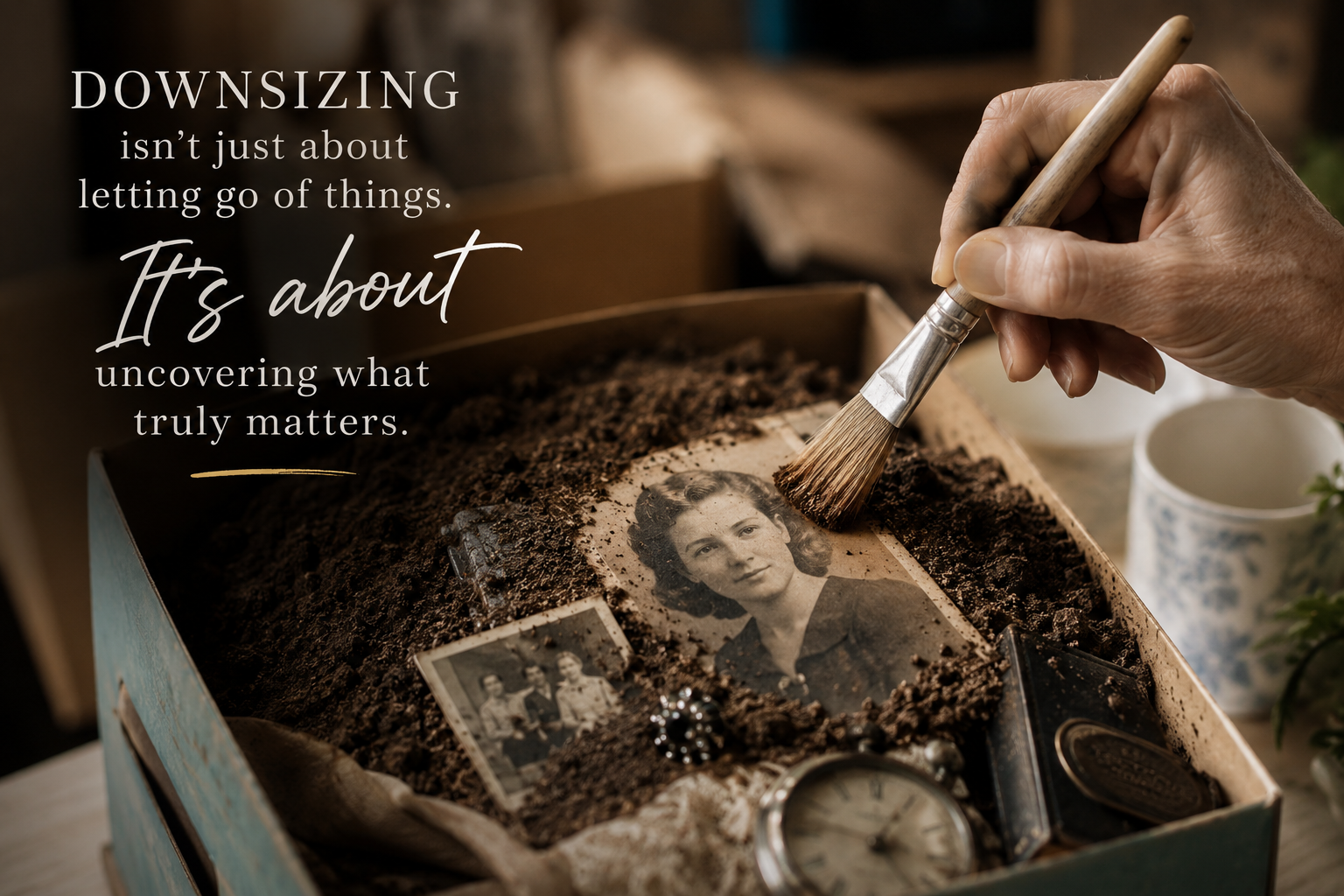
Like an archaeologist carefully brushing away layers of earth, downsizing gives us an opportunity to uncover the stories, relationships, dreams, identities, and experiences that have accumulated throughout our lives.
And some of them have been buried for a very long time.
The Things We Keep Are Often Carrying Something
Consider the china you haven’t used in decades.
Your father’s old tools.
A dress that hasn’t fit since 1995.
Boxes of children’s artwork belonging to children who now have children of their own.
A piece of furniture you don’t particularly like but can’t imagine giving away.
Logically, we may know we don’t need these things. Yet something inside us resists letting them go.
That’s when it can be helpful to stop asking:
“Do I need this?”
And start asking:
“What does this represent to me?”
That question begins the excavation.
The china may represent Sunday dinners at your grandmother’s house.
Your father’s tools may bring back the feeling of standing beside him while he worked.
The dress may remind you of the person you were during an exciting season of your life.
Your children’s artwork may represent years that seemed exhausting at the time but now feel impossibly precious.
The object isn’t necessarily what we’re holding onto.
We’re holding onto what it means.
Don’t Rush the Dig
One of the biggest mistakes we can make when downsizing is believing that every decision should be quick.
Keep. Donate. Sell. Trash.Next.
Efficiency has its place, especially when a move has a deadline. But some possessions deserve more than a ten-second decision. When you encounter something that is unusually difficult to release, consider that resistance an invitation to dig a little deeper.
Ask yourself:
Why is this difficult for me?
What memory is attached to it?
Who does this remind me of?
What part of my life does it represent?
Sometimes the answer will surprise you.
Sometimes We Need to Grieve
Downsizing can bring grief to the surface.
Not just grief over people we’ve lost, but grief over seasons of life that have ended.
The house where the children grew up.
A career that once defined us.
Our younger selves.
Dreams that came true—and sometimes dreams that didn’t.
Traditions that slowly disappeared as families changed.
A possession can become the marker for an entire chapter of our lives.
So when someone says, “It’s just stuff,” they may be missing something important. Sometimes it isn’t just stuff.
But that doesn’t necessarily mean we need to keep it.
It may mean we need to honor what it represents before we release it.
Preserve the Memory, Not Necessarily the Object
Once we uncover the meaning beneath an object, we can decide how we want to preserve that meaning.
Take a photograph. Write down the story.Tell your children why the object mattered.
Record yourself talking about the memory.
Keep one meaningful item from a collection rather than all 30.
Create a small memory book with photographs and stories.
Pass something along to someone who will genuinely appreciate it.
There are many ways to preserve a memory without continuing to store every physical object connected to it.
In fact, recording the story can sometimes preserve the memory better than keeping the object.
A grandchild may have little interest in inheriting a box filled with unfamiliar possessions. But a photograph accompanied by the words, “This belonged to your great-grandmother, and here’s why it mattered to me…” gives the object context.
You’ve preserved the story.
Excavation Helps Us Decide What Comes Forward
Archaeologists don’t keep everything they uncover. They examine what they find.They determine its significance.
Downsizing isn’t about erasing our past. It is about becoming more intentional about what we carry forward from it.
Some things deserve a place in our next chapter.
Others have already served their purpose.
They gave us joy.
They helped us raise families.
They represented accomplishments.
They connected us to people we loved.
We can acknowledge all of that and still say:
“This mattered to me. And I don’t need to own it anymore.”
There is tremendous freedom in those words.
The Real Work of Downsizing
Perhaps this is why meaningful downsizing shouldn’t always be rushed.
Yes, there are closets to empty, boxes to pack, furniture to measure, and decisions to make.
But there is something else happening beneath the surface.We are sorting through our own history.
We are deciding what still serves us. We are acknowledging what shaped us. We are grieving what has ended.
We are preserving what matters and making room for what comes next.
That kind of excavation is worthy of our time and effort.
Because when downsizing is done thoughtfully, we aren’t simply creating a smaller collection of possessions.
We are uncovering our stories, honoring our past, and choosing—perhaps more intentionally than ever before—what we want to carry with us into the future.